
When someone dies, particularly when it is someone we love, there is an enormous amount to take in. There is the grief, of course. But alongside the emotion there can suddenly be a whole series of practical questions.
What happens now? Who do I call? Can I stay with them? When does the funeral director come? Who certifies the death? When do I register it? What am I supposed to do?
A recent article in The Guardian asked a very good question: why do we have information sheets for so many medical conditions, but so little straightforward information about what to do on the day someone dies?
The article, written by oncologist Ranjana Srivastava, described the experience of a family facing the death of a loved one and the uncertainty surrounding the practicalities that followed. Even when a death is expected, the process can feel unfamiliar and surprisingly complicated.
The purpose of this post is to demystify dying because knowing what to expect can make an incredibly difficult time a little less bewildering.
If someone dies at home and the death was expected
If someone has been approaching the end of their life and has been receiving care at home, there will usually be a plan for what happens when they die. This might involve a GP, district nurse, community nursing team, hospice End of Life Doula or other healthcare professional.
If the person dies at home, the appropriate healthcare professional should be contacted so that the death can be formally verified. This will usually be the Community Nursing Team or GP. There is usually no need to call 999 if the death was expected and there is an agreed end-of-life plan.
You don’t have to rush
One of the things that families are often unsure about is what happens to the person who has died. There can be a feeling that everything has to happen immediately but this is not the case.
Where the circumstances allow, families may be able to spend some time with the person who has died before the body is taken into the care of a funeral director. It is possible to keep someone at home for some hours and even days of the conditions are right. An End of Life Doula can help advise and support if you would like to do this.
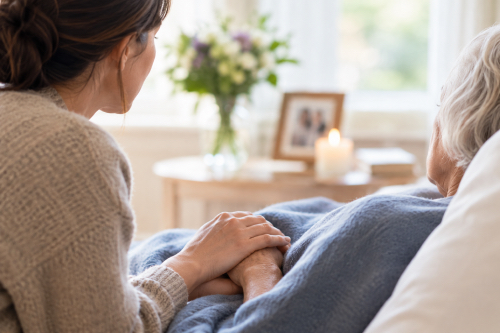
You might want to sit with them, hold their hand, talk to them, play music, pray, invite other family members in, or simply sit quietly. For some people, this time can be an important part of beginning to understand that the person has died.
Someone needs to confirm the death
A healthcare professional needs to confirm that the person has died. This involves a clearly documented process for confirming that there are no signs of life. It includes listening to the heart, examining the eyes and checking for a response to stimulus such as pain.
There is then a process for establishing and certifying the medical cause of death. In England and Wales, the Medical Certificate of Cause of Death (MCCD) is an important legal document. It allows the death to be registered and provides the permanent legal record of the fact and cause of death.
Since the introduction of the medical examiner system, the cause of death is also scrutinised by an independent senior doctor who was not involved in the person’s care. The medical examiner’s office can answer questions about the cause of death and the healthcare provided before the person died and address any concerns. This process can sometimes take a little time.
That can be frustrating when you are grieving, particularly if you are waiting to make funeral arrangements. But the checks are there for an important reason: to make sure deaths are properly certified and that any concerns about the cause of death are identified.
What if the death is unexpected?
The process is different if the person dies unexpectedly, suddenly, or in circumstances where the cause of death is unclear. Some deaths have to be referred to the coroner.
This includes deaths where the cause is unknown or where there is reason to suspect that the death was violent or unnatural. There are also other circumstances in which a coroner must become involved. If a death is referred to the coroner, this doesn’t necessarily mean that anyone has done anything wrong.
The coroner’s role is to establish who the person was, when and where they died, and how and why they died where an investigation is required. The process may involve a post-mortem examination and, in some cases, an inquest. It can mean that the family has to wait longer before the funeral can take place but in some cases the coroner can give permission for the death to be certified without further investigation.
What happens to the person’s body?
This is something often not spoken about before someone dies. After the death has been verified , the person will usually be transferred into the care of a funeral director or, where a coroner is involved, remain under the appropriate arrangements until the coroner releases them.
However there can be choices around what happens next. Depending on the circumstances, families may be able to spend time with the person who has died, have them cared for at home for a period, or visit them at the funeral director’s premises. There are also different options for funerals and what happens to the body afterwards.
Registering the death
Once the necessary medical or coronial process has been completed, the death needs to be registered.
In England and Wales, the medical examiner’s office will confirm when the death can be registered in cases that follow the medical route. The death should normally be registered within five days of receiving confirmation that registration can go ahead.
There are different arrangements where a coroner is investigating the death.
Once the death has been registered, you will receive the paperwork needed for the funeral to proceed. You can also purchase certified copies of the death registration entry. These are often needed when dealing with banks, pensions, insurance companies and other organisations.
Tell Us Once can make things easier
There is an enormous amount of administration following a death. The Tell Us Once service means you don’t have to contact every government department separately.
When you register the death, the registrar will explain the service and either complete it with you or give you a reference number so that you can use it yourself. It can notify a number of government departments and public-sector pension schemes about the death.
There will still be organisations you need to contact yourself, such as banks, mortgage providers, insurance companies, utility companies and some pension providers but you don’t have to do everything on the same day.
And that is perhaps the most important thing to remember
You don’t have to sort everything out immediately. When someone dies, there can be a strange pressure to become an administrator almost overnight. It is okay to take things one step at a time.
Perhaps we should talk about this before someone dies
This is one of the reasons conversations about death and dying matter. Knowing what someone wants at the end of their life isn’t only about medical decisions. It can also be about the practical things.
These conversations don’t have to be formal or morbid, they can happen over a cup of tea and they can be changed.
We shouldn’t have to learn all this when we’re grieving
The Guardian article that prompted this piece makes an important point: we are often very good at giving people information about illness and treatment, but much less good at explaining what happens when treatment ends and someone dies. Death is something most of us will encounter, yet very few of us are taught what actually happens.
Knowing the practicalities doesn’t make death any less sad but it can remove some of the fear of the unknown.
Comments are closed