
We’re making death simpler, cheaper and more convenient. Imagine a future where arranging the disposal of the body of someone you love after they die is as straightforward as booking a holiday online.
No need to source a local funeral director. No need to find time to visit an office in person, sit down with someone or have those rather uncomfortable conversations about what your loved one might have wanted. For convenience, you can even arrange this ahead of time!
Simply log on, select your package, upload the paperwork and press submit.
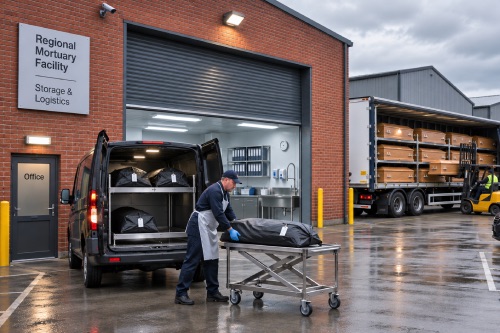
Your loved one will be collected, transported and cremated through a highly efficient, fully automated process. Your nominated person will receive email updates every step of the way, and once everything is complete, a notification will arrive confirming that your order has been fulfilled. Welcome to the future of death care.
The convenience of a national service
Family run, independent funeral directors, with their local premises, personal knowledge and relationships built over generations, are gradually disappearing. Running a funeral business locally is expensive. Staff need paying, premises need maintaining and, perhaps most inconveniently, people need time to talk to grieving families.
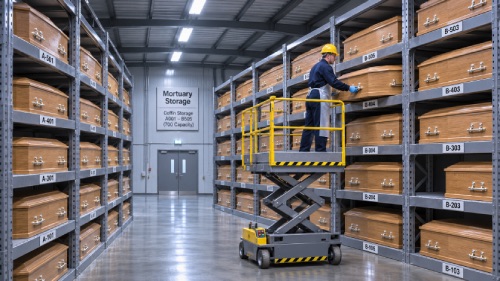
Fortunately, larger national providers have found a much more efficient model. Similar to the incredibly profitable battery farming practices, economy of scale, centralised operations, removal of personalised care, large mortuaries, standardised packages and streamlined processes mean that everything can be managed from one or two locations across the country.
Towns and cities are increasingly short of premises for the booming industries such as vape stores and barber shops so as more local funeral directors close, prime spaces will be freed up for these important enterprises.
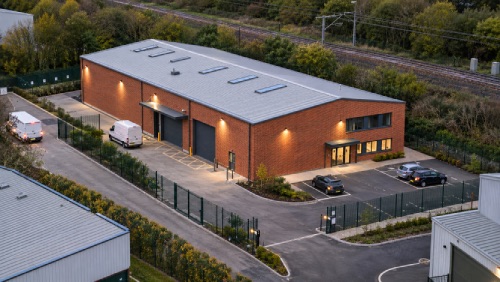
The personal touch? So outdated.
Remember when you had to telephone a funeral director and speak to someone in person? Someone who would listen, ask and answer questions and talk through your options? Those days are numbered. In the future, calls will be handled by simple automated systems and AI assistants.
Press 1 if someone has died at home.
Press 2 if someone has died in hospital.
Press 3 if you need to arrange collection.
Press 4 if you have a question about the cremation process.
Press 5 if you would like to speak to a real person.
And if your question doesn’t fit neatly into a predetermined category? Well, that’s unfortunate, but think of the efficiency!
A body is a body, after all
No need to think about what you would want the person to be dressed in. Simple, they will remain in whatever they are in when they are collected. No pressure to visit or spend time with your loved one, once they are collected they will go to a highly efficient mortuary where they will remain undisturbed until being transferred to the crematorium for disposal.
These are unnecessary decisions, and not required in a streamlined online process. Besides, we’ve now become very good at separating death from everyday life. Perhaps it’s best to leave these things to the professionals.
Progress is inevitable, isn’t it?
Let’s celebrate what we’ve achieved:
- Fewer local funeral directors and less competition.
- More centralised operations and automated processes.
- No need to speak to someone in person any more.
- Fewer decisions to be made as local alternatives disappear.
- Pricing that reflects the National trends.
Most importantly, it will be possible to arrange one of life’s most significant events from the comfort of your office, any time day or night, without having to miss a moment of working time.
But what if we’re measuring progress all wrong?
Although this article is clearly tongue in cheek, the funeral industry is already heading this way. The images in this post are AI generated. However the prompts put into AI were from the actual planning application for a 700 body mortuary facility on an industrial estate in York that has recently been approved .
Perhaps we need to stop and ask ourselves what death care is actually for. It isn’t simply about disposing of a body. It’s about caring for a person who has died and importantly supporting the people who are left behind.
It’s about dignity, choice, compassion and the opportunity to say goodbye in a way that feels right. It’s about having someone to talk to when you don’t know what to do. Someone who can explain the options, challenge assumptions and help you discover that there are often more possibilities than you might imagine. Someone who might just hold your hand, look you in the eye and say that they care.
Technology has a valuable place in the future of death care. Online information, transparent pricing and convenient administration can all make a real difference.
Direct cremation is also a perfectly valid choice for many families. But it should be a choice, not simply the only affordable or accessible option left. It is also widely available through our local independent funeral directors, often at significantly lower cost than the large commercial operations. We should be asking whether the drive towards efficiency is genuinely serving the public, or whether we’re gradually removing the very things that make death care meaningful.
At the End of Life Network, we believe there is another way. We want to see death and dying brought back into our communities. We want people to understand their choices, to feel confident making their own arrangements and to have access to independent support.
We want to see more opportunities for families to care for someone after death, to spend time with them, to say goodbye in their own way and to reclaim some of the rituals that have gradually disappeared from everyday life. We don’t need to turn the clock back. We need to make sure that progress doesn’t mean losing our humanity.
Because perhaps the real measure of a good death care service isn’t how quickly and efficiently a body can be collected, processed and cremated. Perhaps it’s how well we care for the person who has died, and the people who loved them.
Comments are closed