
There is something about nature that speaks when words fall short. My wishes and preferences document says I would love to die on the beach. Realistically I know this is unlikely to be possible however I like to think that perhaps what I love about the beach could be recreated at the time.
At the end of life, when emotions are heightened and families are navigating uncertainty, the natural world offers a quiet kind of companionship. The changing seasons, the movement of leaves in the breeze, birdsong at dawn, or the simple presence of flowers remind us that life is part of a larger cycle—one that includes both beginnings and endings.
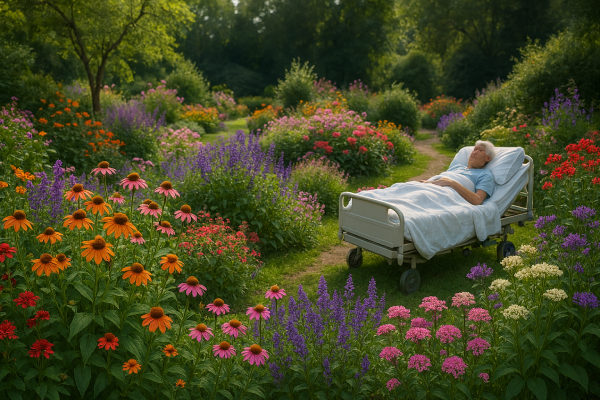
For people who are dying, spending time in nature or simply looking out onto a green space can provide moments of calm, reflection, and connection. While nature can’t remove the sadness of loss, it can help create an environment where comfort, acceptance, and presence become more readily found.
What the Evidence Tells Us
The idea that nature supports wellbeing is increasingly backed by research, including within palliative and end-of-life care settings.
Studies of horticultural and nature-based interventions have shown that engagement with gardens, plants, and outdoor environments can reduce anxiety and emotional distress, improve mood, and enhance quality of life for people living with advanced illness. Some research also suggests benefits in reducing perceived pain, supporting relaxation, and encouraging meaningful social interaction between patients, families, and care staff.
Beyond structured interventions, broader evidence on “restorative environments” in healthcare highlights that access to natural light, greenery, and views of nature can lower stress levels and improve psychological wellbeing for both patients and healthcare professionals working in emotionally demanding settings.
Importantly, these benefits extend beyond the individual who is dying. Families and loved ones often experience anticipatory grief, exhaustion, and emotional overload. Environments that include natural elements can provide spaces for reflection, conversation, and moments of calm that are not always possible in clinical surroundings.
Where Grief Goes Quiet
One powerful example of the role of nature in supporting grief and remembrance is the Where Grief Goes Quiet garden by garden designer Sophie Leo.
Sophie designed the garden to honour her mother who died in 2022. The idea was not to remove grief, but provide a place for reflection and supportive conversation. It offers a living environment where people can pause and simply be with their emotions.
Bringing Nature into Critical Care
There is growing recognition within healthcare that healing environments matter just as much as medical treatment.
A significant example is the rooftop Critical Care Garden at King’s College Hospital in London, which provides a green outdoor space for patients, families, and staff within an intensive care setting. This innovative project allows critically ill patients, where appropriate, to experience fresh air, natural light, and greenery without leaving the clinical environment. It also offers families a quieter, more reflective space during some of the most difficult moments of their lives. The garden is part of a wider commitment to improving wellbeing in critical care and is being explored for its potential impact on recovery, stress reduction, and patient experience.
You can read more about this by following this link
For staff, such spaces can also provide essential moments of respite in highly pressured environments, helping to support emotional resilience and reduce burnout.
Bringing Nature to the Bedside
While gardens and outdoor spaces are invaluable, many people at the end of life are unable to leave their room. In these situations, nature can still be thoughtfully and sensitively brought to them.
Fresh flowers or seasonal foliage placed within view of the bed can soften a clinical environment and offer a gentle sense of life continuing beyond the room. When my Grandmother was at the end of her life I took her fresh lavender as one of her favourite smells. Although she couldn’t speak, I could tell she was enjoying the scent of the flowers.
Maximising natural light by opening curtains during the day, or ensuring the bed is positioned with a view of trees, sky, or a garden where possible, can help create a sense of connection to the wider world. Even something as simple as hearing birdsong through an open window can provide comfort and orientation to time and place. The wishes of the dying person should always take priority however.
Nature can also be brought in through other senses. Photographs of meaningful landscapes, recordings of natural sounds such as rain, wind, or waves, and familiar natural scents like sweet peas or herbs can all evoke memories and promote calm.
Families sometimes bring in small objects collected from meaningful places—a shell from a beach, a pebble from a walking route, a pressed flower from a garden. These objects can become powerful prompts for conversation and reminiscence, helping to affirm identity and life story at a time when these feel especially important. As much loved character Nigel in Eastenders died, he did so with a flat stone in his hand that reminded him of skimming stones with his father at the beach as a child.
These gestures are about presence, connection, and dignity and helping someone feel grounded in who they are and the life they have lived.
Reimagining Compassionate End-of-Life Care
Good end-of-life care is about more than managing physical symptoms. It is about supporting emotional wellbeing, relationships, meaning, and dignity. Nature has a unique ability to support all of these. It does not take away grief or prevent loss, but it can change the experience of it, making space for reflection, connection, and moments of calm.
Initiatives such as the Where Grief Goes Quiet garden and the rooftop Critical Care Garden at King’s College Hospital demonstrate a growing understanding that green spaces are not luxuries in healthcare. They are essential elements of compassionate care.
Even the smallest interactions with nature can become meaningful anchors during the final stages of life.
Comments are closed